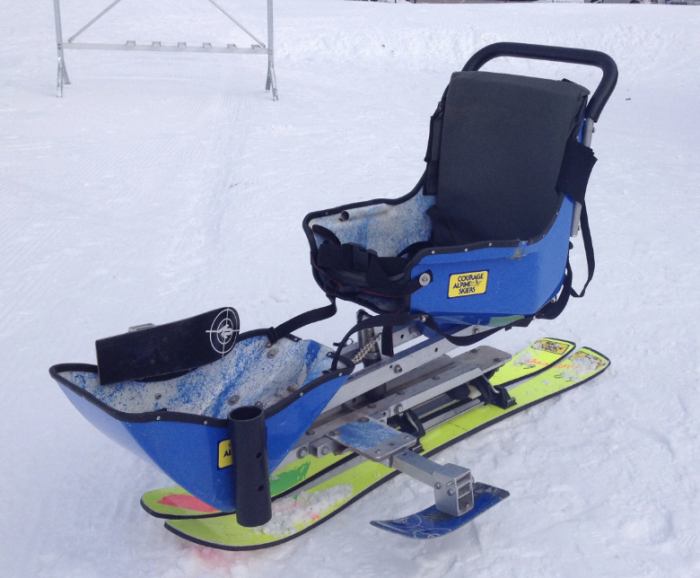
On my home hill the usual sit skier progression starts with a tetherer bringing the sit skier down a green run, with the tetherer making all the decision and doing most of the work. The sitskier is almost a passenger. Then over time more and more control is handed over to the sitskier.
One key step is when the sitskier, rather than the tetherer, is choosing the turns and planning a route down the hill. This is usually done later in the sequence, when the sitskier is already doing most of the turning, and the tethers are slack most of the time. But this is an important step before letting the sitskier off tethers. They need to be able to turn and stop, but they also need to have a good sense of when to turn and stop.
This is a skill we expect able bodied skiers pick up without any explicit training, but in reality a lot of us have got ourselves into tricky situations as a beginner skier. Ending up on steep ice, or too close to a cliff, or just squeezed between a ski school class and the edge of the run. Places where the right answer isn’t to have the skill to get out of the situation, it’s to have the foresight to avoid getting into that situation.
I have had sitskiers top out at this step. These were usually sit skiers who had a mental impairment as well as a physical one. One skier I remember would always end up in the trees on the left of the run. I think it was that whenever there was someone to avoid, he would avoid them by turning left. So our path would wander leftwards over time, until there was no room left. We had to keep him on tethers with the tetherer calling the shots, even though he could turn and stop.
Let’s dig into what happens when we make this switch. Mostly the tetherer stops shouting “Go Left”, “Go Right”. Or on steep pitches “Left, Left, Left, Left, Left. And Right, Right, Right….”. But what happens instead? We need the sitskier and the tetherer to be on the same page. One going left while the other goes right isn’t going to end well.
One option is that the sitskier shouts out the turns as they initiate them. In my experience this doesn’t work well. The sitskier is in front and facing forward, 90% of their voice volume is going to go down the hill. They are also sitting down and strapped in. Add in the noise of other skiers, and a bit of ice, and the tetherer is not going to be able to hear them.
Instead the tetherer needs to watch the sitskier, and both anticipate and react to their movements.
- Are we approaching the side of the run? If so, they are probably going to turn downhill soon.
- Are they turning in a rhythm? Maybe they will continue in rhythm.
- Are we heading towards a fallen or stopped skier? If so, then they will probably turn away, but which way?
- Did they just move their head to look downhill? Or start moving an arm out and forward? Those are probably both the start of a turn.
The nice thing about tethering like this is that it’s quiet. When it works well it’s like the sitskier and tetherer are dancing down the hill, in harmony, but with the sitskier leading (In the dance sense as well as being further down the hill).
The bad thing about tethering like this is that it’s difficult. The tetherer needs to be able to change direction very quickly, and to be very alert to what the sitskier is doing. They also have to “keep their head on a swivel” and be just as aware of everyone else on the hill as when they are calling the turns . The tetherer needs to be able to execute an emergency stop, or call for an emergency turn at any time. If they can’t, what’s the point of them being there?
One thing that can help is keeping tethers loose and long. This gives the tetherer more time to react to a sitskiers turn before the tethers snap tight. Maybe only a split second more time, but it definitely helps.
Another idea is talk to the sitskier (I know, it’s a radical idea 😊 )
Firstly, explain that this is a step towards their independence, and that they need to be looking & thinking beyond one turn.
Secondly, point out that they are planning a path for the two of you, not just them.
- They might be able to cut through a 6 ft/2 metre gap between skiers in a ski school duckling line. But as a tetherer at the far end of a 10 ft/3 metre tethers you won’t be able to go through the same hole.
- A fun thing to do for them might be to find a ridge, almost stop at the top and then turn straight downhill to accelerate off it. You will be a second behind them and doing the almost stop when they are picking up speed, and snapping tethers tight.
Thirdly, practice the big picture planning verbally. Stop at a point whether you can both see a long way down the hill, and describe your thinking, For example: “There is a set of snowboarders sitting in the middle there, but they are starting to get up and will probably be gone by the time we get there. There’s a fallen skier with ski patrol on the left, we should keep well away from them. That ski school group are zig-zagging down the hill, we should probably aim to cross behind them, not ahead or through them, etc.”. Next time ask them to do the same exercise.
One option at this point is to switch to a single tether, which Americans sometimes call a Speed Strap. This allows you to still do emergency stops, but not emergency turns. I would use this with a skier who is pretty good at the planning & turning but hasn’t mastered hockey stops yet. (I find hockey stops one of the hardest things to teach, but I guess that’s a different blog).
This is a little deeper an more specific than a lot of my posts, but please, leave a comment and let me know if it was interesting or useful. Or I guess, even if it wasn’t.